How to Plan a Helicopter Transfer from Bali to the Gili Islands
- It reduces total travel time from over four hours by land and sea to under an hour.
- The flight offers exclusive aerial perspectives of Mount Agung, the Lombok Strait, and the Gili trio.
- It bypasses public ferry terminals and avoids potentially challenging sea conditions.
The low, resonant hum of the rotor blades begins to crescendo, a sound that cuts cleanly through the humid Bali air. Below, the intricate mix of Seminyak’s traffic and verdant rice paddies shrinks with surprising speed. You are ascending, enclosed in a climate-controlled cabin, trading the island’s terrestrial energy for the vast, open sky. Ahead lies the Lombok Strait, a deep sapphire channel separating you from your destination. This is not the standard, sea-sprayed fast boat journey to the Gili Islands. This is an arrival redefined, a transition from one paradise to another that is as elegant as it is efficient, transforming a travel day into a core part of the experience itself.
Beyond the Fast Boat: The Case for an Aerial Arrival
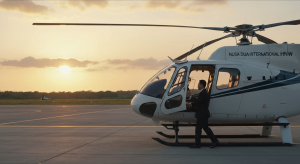
For decades, the default transit to the Gili Islands involved a multi-stage, often wearisome, journey. The typical itinerary requires a 90-minute to two-hour drive from southern Bali’s luxury enclaves to the crowded port of Padang Bai, followed by an unpredictable 90-minute fast boat crossing. “Our high-net-worth clients value their time more than anything,” explains Jean-Luc Reymond, a Bali-based luxury travel consultant. “When you factor in traffic, port waiting times, and potential sea-sickness on a rough crossing, you’ve lost nearly five hours. A bali heli transfer reclaims that day.” The aerial distance from Bali’s southern heliports to Gili Trawangan is approximately 55 kilometers, a distance covered by an Airbus H125 helicopter in a mere 45 minutes.
The value proposition extends far beyond simple time-saving. It’s about control and comfort. Helicopter charters operate on your schedule, not a fixed ferry timetable. This allows for seamless connections from international flights arriving at Ngurah Rai International Airport (DPS) or leisurely departures after a late checkout from your villa. Furthermore, the experience circumvents the chaos of public terminals entirely. There are no queues, no jostling for luggage, and no concerns about weather-related ferry cancellations, which can be common during the rainy season from November to March. The transfer becomes a private, serene aerial tour, setting a tone of exclusivity from the moment of liftoff. For a four-day escape, this efficiency is paramount, ensuring you arrive refreshed and ready to experience the islands, rather than recovering from the journey to get there.
The Logistics of the Sky: From Booking to Touchdown
Planning a helicopter transfer from Bali to the Gili Islands is a bespoke process, distinct from booking a commercial flight. The first step involves engaging a reputable charter operator or a specialized service like Bali Heli Transfer Discovery. We recommend initiating the booking process at least three to four weeks in advance, particularly during the peak seasons of July, August, and the December holidays, when aircraft availability is at its lowest. The most common aircraft servicing this route are the Airbus H125 (formerly AS350) and the Bell 206L LongRanger, which typically accommodate four to five passengers plus the pilot.
A critical consideration is luggage. These aircraft have strict weight and space limitations. The standard allowance is approximately 15 to 20 kilograms per person, and operators universally require soft-sided duffel bags rather than rigid suitcases. This is non-negotiable, as soft bags can be manipulated to fit into the compact cargo hold. Pricing for a one-way charter generally falls between $4,500 and $6,500 USD, depending on the aircraft and departure point. Departures are typically staged from dedicated heliports in the Nusa Dua or Benoa areas, or directly from a private section of DPS airport for ultimate convenience. The arrival point is not on a beach, but at a certified helipad on Gili Trawangan. From there, a coordinated, private speedboat completes the final five-minute leg of the journey to your resort’s doorstep—a detail that underscores the seamless, door-to-door nature of the service.
The Flight Path: A 45-Minute Journey Over Geological Wonders
The flight itself is a masterclass in Indonesian geography. Lifting off from southern Bali, the aircraft banks east, providing a final, sweeping view of the Bukit Peninsula’s limestone cliffs and the luxury resorts lining the Indian Ocean. The route crosses the Lombok Strait, a formidable channel that plunges to depths of over 1,300 meters. This strait is a significant biogeographical boundary known as the Wallace Line, separating the ecosystems of Asia and Australasia. To the north, Bali’s sacred Mount Agung dominates the horizon, its 3,031-meter peak often shrouded in a thin veil of clouds. On the opposite side of the strait, the even more imposing Mount Rinjani on Lombok rises to 3,726 meters, its caldera a monumental feature visible from 100 kilometers away.
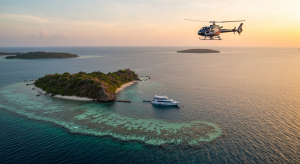
As you approach the Gili archipelago, the perspective shifts from the grand to the intimate. The three islands—Trawangan, Meno, and Air—appear like distinct jewels set in a turquoise sea. From an altitude of 1,500 feet, the intricate patterns of the surrounding coral reefs become visible through the crystalline water. “My most frequent request from passengers is to make one slow circle of the three islands before we land,” shares Captain Eva Rostova, a veteran pilot with over 4,000 flight hours in the region. “It helps them orient themselves and appreciate the unique character of each island. You can see the bustling east coast of Trawangan, the serene salt lake on Meno, and the ribbon of beaches on Air. It’s a perfect introduction.” This is a key advantage of a private charter; the flight path has a degree of flexibility that a scheduled service could never offer, making the journey an integral part of your definitive guide to helicopter travel in Bali.
Vetting Your Operator: A Focus on Safety and Service Standards
While the allure of a helicopter transfer is powerful, the selection of an operator must be guided by an uncompromising focus on safety and professionalism. In Indonesia, all legitimate air charter services must hold an Air Operator Certificate (AOC) issued by the Directorate General of Civil Aviation (DGCA). This certification ensures the operator meets stringent requirements for aircraft maintenance, pilot training, and operational protocols. We advise clients to verify an operator’s AOC and inquire about their specific safety record. A transparent operator will readily provide this information.
Beyond regulatory compliance, consider the fleet and crew. Aircraft like the Airbus H125 are renowned for their performance and safety in high-altitude and hot conditions, making them exceptionally well-suited for this region. Pilots should possess extensive experience, not just in total flight hours, but specifically in navigating the microclimates and archipelagic terrain of Indonesia. The service component is equally critical. A premium bali heli transfer is a fully managed experience. This includes coordinated ground transportation in a private vehicle to the departure heliport, expedited check-in, and seamless communication with your Gili Islands resort to ensure their staff is waiting with a private boat at the helipad upon your arrival. This level of logistical integration is what distinguishes a luxury provider. For further information on traveling within the country, the official tourism board, indonesia.travel, offers a wealth of resources for discerning visitors.
An Archipelagic Triptych: The Three Gilis from Above
The aerial approach to the Gili Islands offers a unique strategic overview, revealing the distinct personality of each islet before your feet ever touch the sand. Gili Trawangan, the largest at 3.4 square kilometers, is the first to command attention. From the air, its social geography is clear: a vibrant cluster of development lines the eastern shore, marking the main boat harbor and the concentration of restaurants and beach clubs. To the west and north, a quieter landscape of private villas and upscale resorts unfolds, promising a more secluded experience. The flight path often provides a glimpse of the Rinjani-Lombok UNESCO Global Geopark on the mainland, a testament to the region’s geological significance.
To the east of Trawangan lies Gili Meno. Even from a thousand feet, its tranquility is palpable. The island is noticeably less developed, with a prominent saltwater lake visible in its western interior. Its coastline is an almost unbroken ring of white sand, and the famous underwater “Nest” statues by Jason deCaires Taylor can sometimes be identified as a dark patch in the turquoise shallows off its western coast. Finally, there is Gili Air, the closest to the Lombok mainland. It presents a balanced character—more amenities and life than Meno, but more relaxed than Trawangan. From the helicopter, you can trace the sandy path that circumnavigates the island, dotted with bungalows and small cafes. Understanding these three distinct options is a crucial part of planning, a subject covered in depth within our comprehensive guide to Bali helicopter travel.
Quick FAQ: Your Helicopter Transfer Questions Answered
What is the precise luggage allowance for a helicopter transfer from Bali to Gili Islands?
The allowance is strictly enforced and typically ranges from 15 to 20 kg per passenger. Crucially, all luggage must be in soft-sided bags or duffels. Hard-shell suitcases cannot be accommodated in the helicopter’s cargo compartment. Excess luggage can often be transported separately via a ground and sea courier for an additional fee.
Can the helicopter land directly at my hotel on the Gili Islands?
This is highly unlikely. Landing is restricted to certified helipads for safety and regulatory reasons. The primary landing zone is a dedicated helipad on Gili Trawangan. From there, your charter operator will have pre-arranged a private speedboat to transfer you and your luggage directly to your hotel’s beachfront, a journey of 5 to 10 minutes.
What is the protocol for bad weather or flight cancellations?
Safety is the absolute priority. The pilot has the final authority to delay or cancel a flight due to adverse weather conditions, such as heavy rain, low cloud cover, or high winds. Reputable charter companies have clear cancellation policies. They will typically attempt to reschedule for a later time or the following day. If rescheduling is not possible, a full refund is standard. Planning this through a trusted service like Bali Heli Transfer Discovery ensures you have support in arranging alternative transport.
How many people can fly in the helicopter?
The most commonly used helicopters for the Bali to Gili route, such as the Airbus H125 or Bell 206L, can accommodate 4 to 5 passengers in addition to the pilot. For larger groups, a second helicopter would need to be chartered to fly in tandem.
The journey between Bali and the Gili Islands should not be a mere logistical necessity, but rather the elegant prologue to your island escape. By choosing an aerial route, you exchange hours of ground travel and uncertain seas for 45 minutes of sublime perspective and absolute comfort. It is an investment in time, serenity, and an experience that provides a profound appreciation for the dramatic beauty of the Indonesian archipelago. To explore aircraft options, receive a bespoke quote, and allow our team to orchestrate your seamless aerial journey, please visit our experts at Bali Heli Transfer Discovery. Let us arrange your next bali heli transfer with the precision and style you deserve.