What Is the Best Time of Year for a Bali Helicopter Tour?
- Peak Visibility: Minimal haze and cloud cover provide unobstructed views of volcanoes, coastlines, and rice terraces.
- Stable Weather: Lower humidity and minimal rainfall reduce the chance of weather-related delays or cancellations.
- Ideal Photography Conditions: Bright, consistent sunlight is perfect for capturing vibrant aerial photographs and videos.
The rotor wash kicks up the scent of frangipani and salt from the helipad at Nusa Dua. Below, the Robinson R66 helicopter gleams, its cockpit a bubble of potential. As the turbine spools up, the familiar vibration builds—a promise of ascent. We lift, a smooth, vertical climb, and the sprawling resorts shrink into intricate patterns. The reef emerges, a sudden slash of turquoise and sapphire against the deep Indian Ocean blue. This is the moment of revelation, the instant Bali’s map-like beauty becomes a three-dimensional reality. But timing this moment is everything. The difference between a good flight and an memorable one isn’t the destination; it’s the calendar. Deciding on the best time for a Bali helicopter tour requires an insider’s understanding of the island’s microclimates and rhythms, a science we have perfected over thousands of flight hours.
Decoding Bali’s Two Seasons: The Dry Season Advantage (April-October)
Any seasoned traveler to the Indonesian archipelago knows the climate is dictated by two distinct seasons: wet and dry. For aerial exploration, the dry season, running roughly from April through October, is unequivocally the premier window. During these months, the southeast trade winds bring arid air from the Australian continent, resulting in a dramatic drop in humidity and precipitation. Daily rainfall averages less than 50 millimeters, compared to over 300 millimeters in January. This translates to consistently clear skies, particularly during the morning and midday hours. Visibility from our cruising altitude of 1,500 feet can extend for over 15 kilometers, rendering the entire southern peninsula, from the cliffs of Uluwatu to the shores of Sanur, visible in a single, sweeping panorama. This is the time to see Mount Batur and Mount Agung free from their frequent shrouds of cloud, their volcanic calderas stark and magnificent. I spoke with Ketut, one of our senior pilots, who has logged over 2,000 flight hours above the island. “July and August are perfect,” he told me, banking over the Tegalalang Rice Terraces. “The air is so stable, we can provide an exceptionally smooth ride, and the sun angle makes the water over the Nusa Islands look like glass.” The trade-off, of course, is that this is also peak tourist season. Flight slots, especially for sunset tours, fill up weeks in advance. If your heart is set on this period, booking your bali heli transfer experience well ahead of time is not just recommended; it is essential.
The Shoulder Months: A Savvy Traveler’s Secret (April-June & September-October)
While July and August represent the pinnacle of perfect weather, the true connoisseur of travel often looks to the shoulder months. April, May, June, and again in September and October, offer a sublime balance of excellent conditions and diminished crowds. These periods are the sweet spot, where the odds of clear weather remain exceptionally high—think 25 sunny days out of 30—but the peak season surge has either not yet begun or has just subsided. In May, the rice paddies are often at their most verdant, a vibrant, electric green before the harvest, making a flight over the UNESCO-listed Jatiluwih rice terraces a cartographer’s dream of emerald and gold. By September, the sun has a softer, more golden quality, which is ideal for photography. Hotel occupancy rates can be 15-20% lower than in August, and the ambient energy of the island feels more relaxed. From the air, this is palpable. You see fewer boats tracing lines across the water between Lembongan and Penida, and the traffic along the coast appears more fluid. This is also a fantastic time to consider a bespoke charter, perhaps combining a volcano tour with a drop-off at a secluded beach club. The operational flexibility is greater, and the experience feels more exclusive. For those seeking the optimal intersection of value, weather, and tranquility, these four months represent the best time for a Bali helicopter tour, a detail we always highlight in our definitive guide to helicopter travel in Bali.
Flying in the Wet Season: A Calculated Risk for Dramatic Views (November-March)
To dismiss the wet season, from November to March, would be to miss a unique and dramatic facet of Bali’s character. This period, dominated by the northwest monsoon, brings higher humidity and short, intense downpours, typically in the afternoon. So, is it a good time for a helicopter tour? With the right mindset and a flexible schedule, absolutely. The island’s flora is at its most lush and explosive during these months. Waterfalls, like the Gitgit or Sekumpul in the north, which are mere trickles in the dry season, become roaring torrents of water—a formidable sight from above. The post-rain clarity can be astonishing. After a 2 PM squall passes, the air is scrubbed clean of dust and haze, revealing colors and details with a startling intensity. Our flight operations team monitors weather cells with meteorological precision. A flight might be shifted from 3 PM to 10 AM to take advantage of a clear morning window. Safety is the non-negotiable priority; we will never fly in unsafe conditions. But the reward for this flexibility can be immense: witnessing towering cumulonimbus clouds building over the ocean, or seeing rainbows arch over the jungle canopy. According to Indonesia’s official tourism board, this season also sees a different type of visitor, often more focused on wellness and culture. A flight during this time offers a more contemplative, powerful perspective of the island’s raw, natural energy.
Time of Day: The Golden Hour vs. Midday Clarity
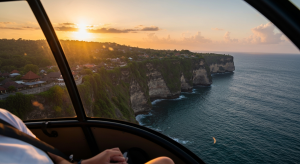
Beyond the season, the specific time of day you choose to fly will fundamentally shape your experience. The debate between a “golden hour” flight and a midday tour is a frequent topic among our clients. The golden hours—the first hour after sunrise and the last hour before sunset—are a photographer’s nirvana. The low-angled sun casts long, dramatic shadows that sculpt the landscape, accentuating the contours of the Uluwatu cliffs and the ridges of the rice terraces. The light is soft, warm, and diffused, bathing the island in a palette of gold, orange, and pink. A sunset tour, watching the sun dip below the horizon from 1,000 feet above Tanah Lot temple, is an almost spiritual experience. The trade-off is slightly reduced visibility into the water, as the angled light creates more surface reflection. Conversely, a flight between 10 AM and 2 PM offers maximum solar illumination. This is the time for pure, unadulterated clarity. The sun is directly overhead, penetrating deep into the water. From this vantage point, you can clearly distinguish coral bommies, track manta rays off the coast of Nusa Penida, and see the famous “underwater scooter” statues near the Gili Islands. The colors of the ocean are at their most vibrant, a spectrum of blues from pale aquamarine to deep indigo. For those whose priority is seeing the marine topography and getting that iconic, crystal-clear shot of the reef, midday is the undisputed champion. The choice is less about which is better, and more about what you wish to see and feel.
Aligning Your Flight with Balinese Culture: Nyepi and Galungan
A truly sophisticated itinerary considers not just meteorology but also the island’s unique cultural calendar. Certain Hindu holidays can profoundly impact, or enhance, a helicopter tour. The most significant is Nyepi, the Balinese Day of Silence, which typically falls in March. On this day, the entire island shuts down for 24 hours. All activity ceases, lights are kept low, and even the international airport, I Gusti Ngurah Rai (DPS), closes completely—the only airport in the world to do so for a religious holiday. As you might guess, there are absolutely no flights. It is a day of profound stillness, as noted on its Wikipedia page. Attempting to schedule a flight around this date requires careful planning. Conversely, the Galungan and Kuningan festival period, which occurs every 210 days, offers a visual feast from the air. During this 10-day celebration, the streets are lined with elaborate, towering bamboo poles called *penjor*, which are decorated with coconut leaves and offerings. Flying over villages during Galungan provides a unique perspective on this island-wide celebration, the curved *penjor* creating a beautiful, recurring motif along every road and in every family compound. Planning your flight to coincide with the day before Galungan allows you to witness the island in its most festive and decorated state, a truly insider experience that adds a layer of cultural depth to the magnificent scenery.
Quick FAQ: Your Bali Helicopter Tour Questions Answered
What is the absolute single best month to fly?
For pure weather reliability and magnificent clarity, our pilots consistently name August. However, for a balance of great weather, fewer crowds, and lush landscapes, my personal recommendation is May or September. These months offer the best of all worlds.
Can we still fly if it’s raining?
It depends entirely on the nature of the rain and associated conditions like wind and visibility. A light, passing shower is often not an issue. However, for heavy tropical downpours or low-lying cloud cover, flights will be rescheduled for your safety and comfort. Our ground crew and pilots make the final call based on real-time data.
How far in advance should I book for a high-season flight?
For the peak months of July and August, we recommend booking a minimum of four to six weeks in advance, especially for specialty tours like a sunset flight or a private charter. For shoulder season, two to three weeks is generally sufficient, though booking earlier is always wise.
Does the price of a helicopter tour change by season?
While our base charter rates remain consistent, package availability can be more limited during the high season due to demand. Some partner experiences, like resort landings or picnics, may have seasonal pricing. It is always best to inquire directly for a quote for your specific dates to ensure accurate pricing and availability for your preferred Bali helicopter tour.
Ultimately, the “best” time is a confluence of factors: your tolerance for crowds, your photographic ambitions, and your desire for either sun-drenched clarity or moody, dramatic landscapes. The island reveals different versions of its beauty throughout the year, each with its own merit. The dry season offers reliability; the wet season offers drama; the shoulder season offers a perfect compromise. The constant is the transformative perspective that only an aerial view can provide. When you are ready to choose your season and craft an itinerary that transcends the ordinary, our team is here to orchestrate every detail. Explore our curated experiences and begin planning your bespoke bali heli transfer today.